
School Blog
Page: 7 of 13 | Entry: 61 to 70 | << next | previous >>
The Granada International Tangofestival 2020

The Granada International Tangofestival 2020. Again it will be a week of shows, exhibitions and street activities. A busy schedule that, among other stars, will also feature the participation of guests such as the Italian tenor Fabio Armiliato, who will accompany the Orchestra and Choir of the University of Granada, or the dance couple composed of Hugo Mastrolorenzo and Agustina Vignau.
Download the festival programme here!
The Granada International Jazzfestival 2019
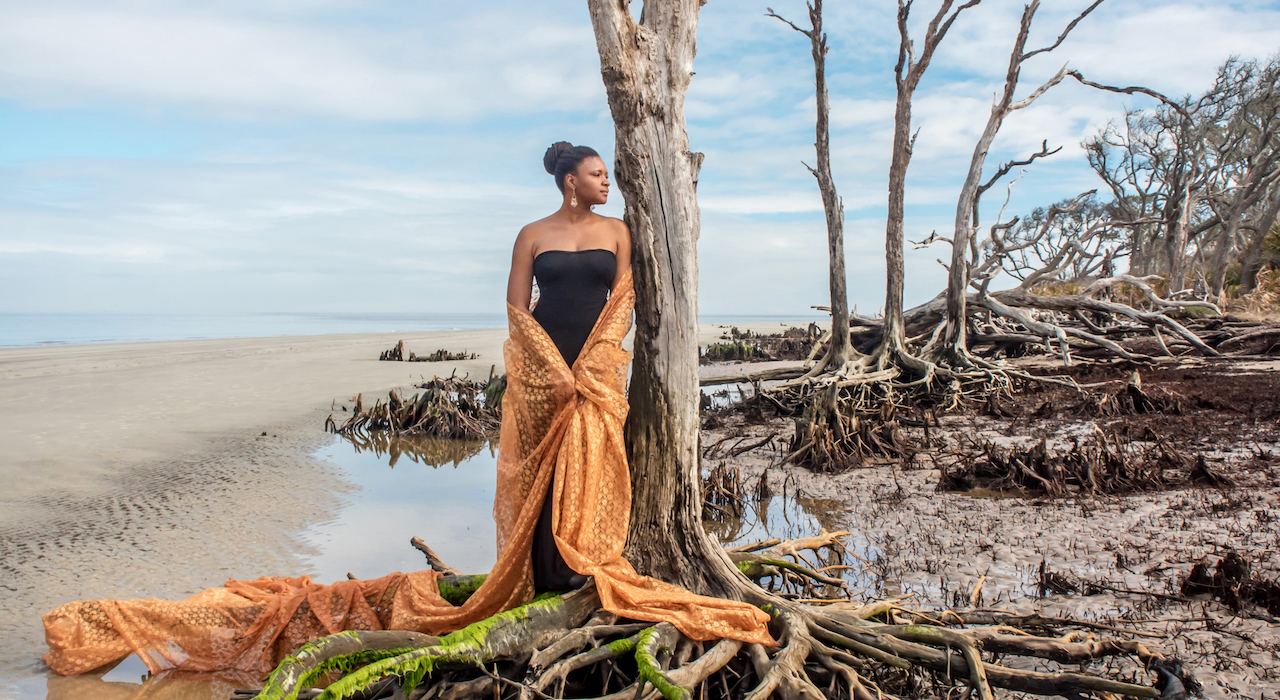
On Friday, 08 of November 2019 Lizz Wright is going to participate in the Granada International Jazzfestival. The Festival is one of the oldest and most important ones in Europe.
Acclaimed vocalist Lizz Wright is a steward of American music bringing brilliant color and vibrancy to singular original works and compositions by some of the greatest songwriters of our time. Wright has garnered widespread attention as one of the most venerable popular singers of her generation through the release of five critically acclaimed albums.
Check the whole programme on the official festival website
Flamenco at the Alhambra in Granada
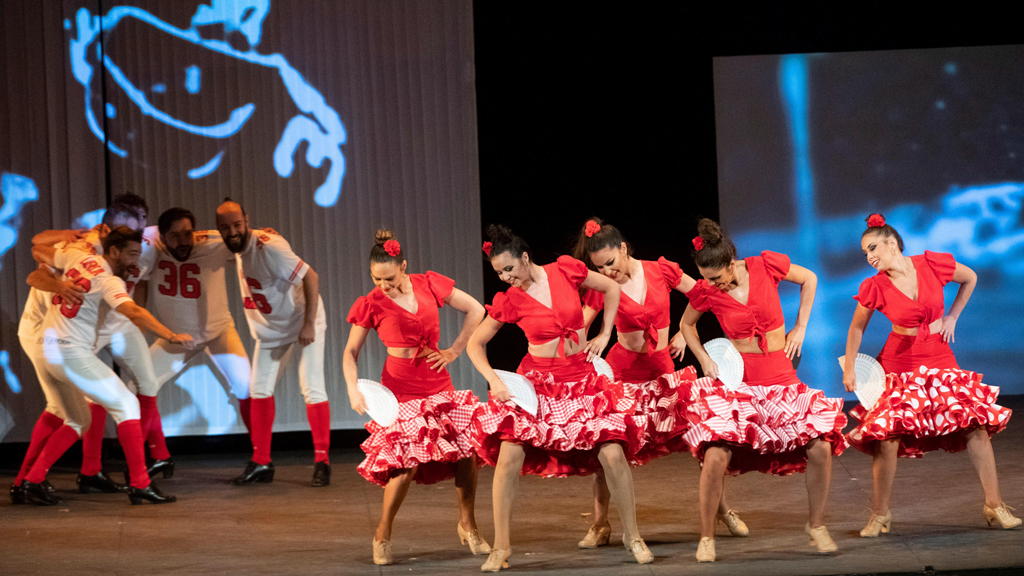
The Agencia Andaluza de Instituciones Culturales in collaboration with the Alhambra founded a programme called Lorca y Granada.
The performances have taken place in the Generalife Gardens since 2002.
The leading figure of Federico García Lorca and the knowledge of his work all over the world are joined with the evocative power of flamenco to make the perfect formula for this artistic proposal.
The Alhambra serves as an extraordinary space for a great technical and artistic performance that inspires, every summer, the expectatives that society has about the world of culture: artistic, touristic, cultural industry and the connection with the audience. This summer the performance is directed by Marina Heredia.
This performance seeks to answer the question: What is love?. And it does so through a reflection on feminine love in the universe of Lorca.
The performance consists of 4 different pieces, seamlessly interwoven without interruptions, going from 'El Público' to 'La Casa de Bernarda Alba', continuing with 'Así que pasen cinco años' and ending with 'Mariana Pineda'.
The performance alternates the most modern and least known works by Federico García Lorca.
International Music and Dance Festival of Granada
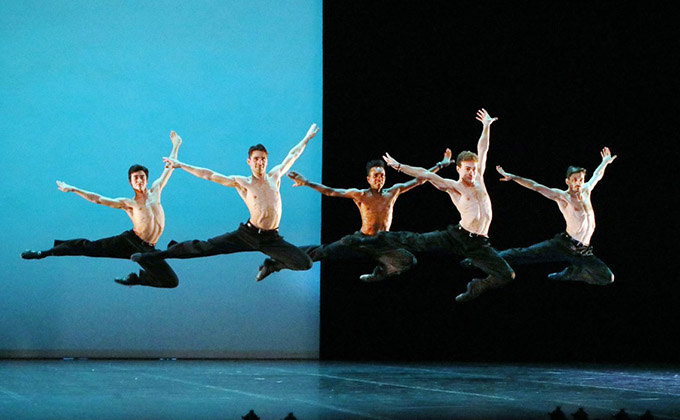
The International Festival of Music and Dance of Granada is a living instrument of cultural, educational, tourist and socioeconomic activity. It takes place from 21.06 to 12.07.2019.
This is reflected not only in the programmes and their contents, but also in the way in which these activities are presented to audiences.
Emotion expressed in artistic offerings of outstanding quality; emotion in the enjoyment of the most beautiful and original spaces in Granada and its province; emotion in the discovery of what Granada has to offer in the way of unique experiences in cultural tourism which each year are discovered by more people from every corner of Spain and abroad; emotion and satisfaction in the realisation that, for a few weeks, the Granada Festival becomes a real motor of the city's economy on account of the thousands of artists, orchestras, companies and visitors who arrive specifically to attend this feast of the senses.
The palaces and the gardens of the Alhambra are this Festival's most impressive sign of identity and a unique setting for its performances. At the beginning of summer hundreds of spectators enjoy the music and the dance, infused by the aroma of the lush vegetation of the gardens of the Alhambra and under the impact of the amazing Nazrid, renaissance and romantic architecture which has made of Granada the so-called Gateway to the South.
And side-by-side with the performances that take place in the Alhambra there is a broad mosaic of artistic events which extends throughout Granada and its province and is available for public enjoyment: this is the FEX which represents the extension of the Festival throughout the city and the province of Granada.
We hope that you will take part in these activities in the Alhambra's palaces and the gardens, at the century-old sights of historic Granada and in the modern city too.
For further information visit: www.granadafestival.org
The International Granada Tango Festival
With the wondrous Alhambra as its centrepiece, the ancient city of Granada – in the heart of Spain's south-west – is a must-see place. A gathering of superb restaurants and a thriving shopping scene, coupled with great beaches less than an hour away, make holidays to Granada a top choice:
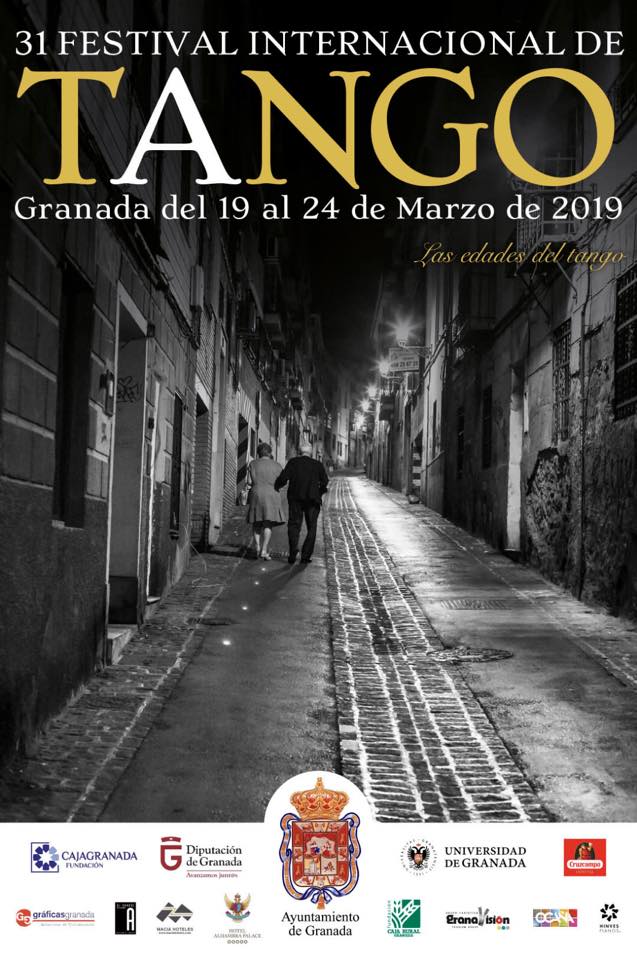
Granada is one of the cities whose festivals are remembered for a long time because locals know how to have fun like nobody else. One of the most interesting events in the city's festival life is the International Granada Tango Festival. Tango is loved not only in Argentina - the festival is one of the best local events of this kind outside the country of its origin. It falls on in March, and colorful actions can be seen at Teatro Isabel La Católica.
Many of our students choose to simply kick back and watch the professionals work their Tango magic on the floor, but the brave take lessons and have a go at this passionate and fiery dance.
Book Tango lesons at our school during this period as a complement to a Spanish course in the morning. And during the evenings you have the chance to visit the different performances everywhere in the city.
For further information download the Festival Programme here!
The best of Flamenco in Granada
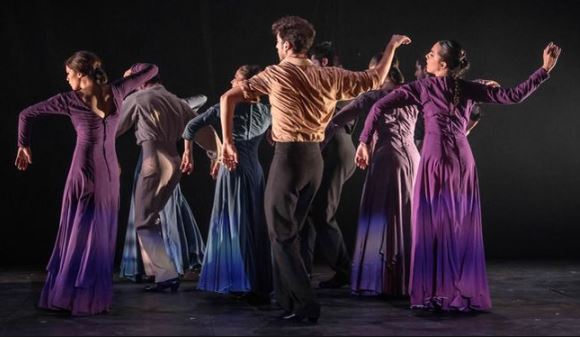
Flamencolorquiano just started on July 19th in the Alhambra Gardens.
What: Lorca y Granada en los Jardines del Generalife en la Alhambra
When: July 19th – September 1st, 2018
Where: Alhambra, Teatro del Generalife
The grand show Flamencolorquiano is the conjunction of two major aspects of Spanish culture and the best of both worlds: it combines the works of the famous poet Federico García Lorca and the art of modern Flamenco dance. On top of that it takes place in an open-air theatre located in the breath-taking Alhambra district, Granada's major attraction. The presentation includes, of course, choreographic dance and music but also provides scenic performances, arrangements of Lorca's poems, songs and stage plays.
This year the ensemble of the Ballet Flamenco de Andalucía performs on stage. It is the splendid world leader of Flamenco dance displaying both tradition and modernity up to avantgarde challenging the audience and, at times, astonishing us and leaving us with a sense of surrealness. Singer María Terremoto, amongst others, will bring Lorca's words and texts to life with special collaboration with Flamenco singer Arcángel.
The event started off in 2002. Thus, this year we are looking forward to participating in its 17th edition. Every year it is staged by various Spanish and international directors. Originally the event was created by Rafael Estévez, the most successful choreographer of Flamenco dance. This time he is directing the show himself supervising the artwork and dance, the musical concept, arrangement of the texts and the scenery.
Federico García Lorca who was born near Granada and was murdered by fascists at the beginning of the Spanish civil war, is considered maybe the country's most famous modern writer and is well-known all over the world. He studied in Madrid where he became close friends with Salvador Dalí. Lorca's poetry collection Romancero gitano was the best selling work of poetry in 20th century Spain.
Escuela Montalbán, our Spanish language school, will be organizing group excursions to the Flamencolorquiano every week throughout the duration of the event. If you like to join the event after your Spanish course, just subscribe to the list at the school's pinboard.
Granada International Festival of Music and Dance
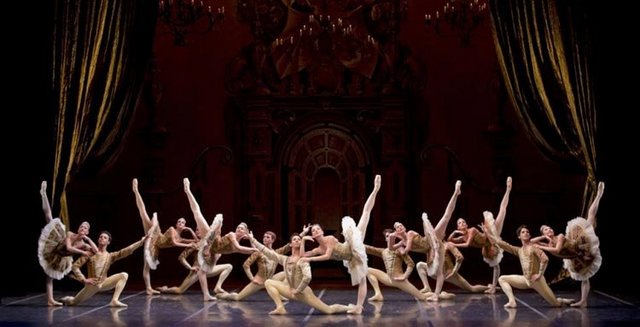
There can surely be few better settings in which to listen to high quality music than some of Granada's emblematic, renowned venues.
Consequently, the annual International Festival of Music and Dance, which has started on the 22.06.2108 and will finish on the 14.07.2018 provides a perfect experience for lovers of music and dance.
The events take place at the King Carlos V Palace, in the Generalife Gardens, in el Patio de los Arrayanes in the heart of the Alhambra and various other of Granada's historic churches and buildings.
The Festival can trace its beginnings back to 1883 when a series of symphonic concerts were held in the King Carlos V Palace during the Corpus Christi celebrations. Later, in 1922, the Cante Jondo contest for Flamenco singers took place in the Alhambra with such notable artists as Federico García Lorca and Manuel de Falla attending.
The event now encompasses many differing styles and genres in its concerts. The late nights of Flamenco music and music from all around the world can be unofficially listened around Albaicín and Sacromonte.
The whole of the city comes alive with the sound of not only typically Spanish guitars, and flamenco dancers but also with the music brought to the city by its many visitors.
For further information visit: www.granadafestival.org
Granada Film Festival: Cines del Sur
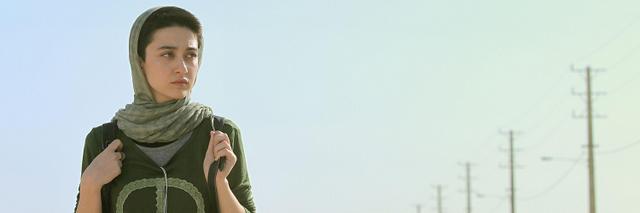
The aim of the Granada Film Festival Cines del Sur is to disseminate and promote films made in the countries of the so-called geopolitical south. Thus, the Festival will provide a space for the meeting of both young filmmakers and established talents from these countries, allowing for the screening of both new productions and emblematic and historic works.
There was a time, back in the fifties, when the West discovered cinema from the East. Such cinema, obviously, had been around for some time, but it had rarely reached our screens and we knew almost nothing about it. We then discovered the work of its great masters, the main lines of strength of its production, its most frequent genres and subgenres. With time, oriental film even became a favoured topic of theoretical attention and academic work. The voyage is far from over, although the geopolitical South soon began to take on clear protagonism in specialized journals and festivals all over the world.
In the age of the new cinemas (with Latin America being at the head) and the
emergence of young filmmakers in the most remote corners of the planet, this South was demanding the attention it had never before received and the
international circuit of festivals finally seemed willing to comply.
The Granada Festival Cines del Sur has joined that circuit, and it does so with the intention not of making untimely discoveries but rather of contributing to the public's knowledge about a subject the wealth and diversity of which have been amply demonstrated. Far from falling into that monolithic stereotype which, from comfortable ignorance, some people attribute to them, cinemas from the South offer images as varied as they are vibrant, and which our Festival now
intends to make available to the public, for the enjoyment of viewers.
Fiction and documentary -as well as any middle ground or hybrid formula-, commercial productions and films of the auteur tradition, celluloid and digital ... all quality films produced in the South will find a place within the design of the Granada Festival.
For further information visit the Festival Website!
THE MAY CROSSES FESTIVAL IN GRANADA
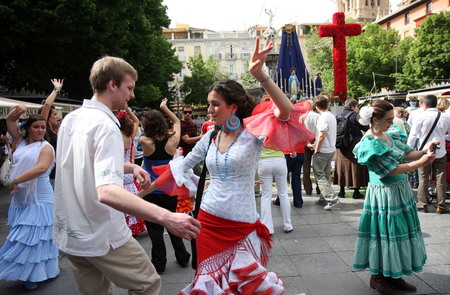
The May Crosses Festival (Cruces de Mayo) is celebrated in many parts of the world. In Spain, the festival holds special importance in many parts of Andalusia, but especially in Granada.
Squares, patios and balconies are adorned with floral crosses, beginning three days of revelry.
The May Crosses festival is always at the beginning of May. It is actually more than a festival - it is also a contest, with neighbourhood associations competing for prizes for the best-decorated cross from town hall. The preparations take place in the preceding weeks, with people from each street or neighbourhood joining in with the decorating of their cross.
The crosses are judged according to criteria along the lines of: the decoration of the cross itself, the floral variety used, the lighting, and use of existing environmental elements (trees, walls etc).
The crosses are about three metres high, decorated with flowers, usually in red or white and sometimes with more foliage emerging from the upper part of the cross, including its three points, or patterns imposed on the base colour. The effect is further enhanced by more flowers (often pink and white) in pots in a carefully arranged pattern to complement the cross, hanging on the wall behind it, placed at its foot, or going up the steps on which it sits.
Each neighbourhood association sets up a bar next to its cross to serve drinks (try the fino sherry) and tapas to the partygoers. Let's not forget the music. In addition to the Sevillanas played during the day, with many local women dancing in their gypsy dresses, there are live performances local flamenco singers and groups or even rock bands at night.
In Granada the crosses are installed on the day of the festival, and remain in place until late in the evening.
The Holy Week in Granada
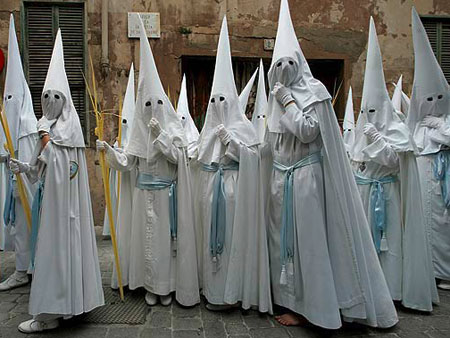
The Semana Santa in Granada is very unique and it is renowned for the simplicity and beauty of its pasos and also for the unique surroundings of the processions.
There are numerous unforgettable moments in the Easter celebrations in which more than 30 brotherhoods (cofradias) participate. Unique settings such as the Albaicín quarter, the Alhambra and the Sacromonte hills fill with processions, religious figures and carvings.
The streets of the Albaicín, so narrow and twisted with their typical cobblestones, give a special setting to some of the processions.
Unforgettable images await the visitor, like those of the procession of El Cristo de los Gitanos. On the night of Holy Wednesday it is the turn of this procession, a spectacular and moving sight thanks to the huge fires lit in the caves of Sacromonte. The procession returns to the home church after midnight by the Carrera del Darro.
On Holy Thursday the procession of the Cristo de Silencio takes place. The silence is only broken by the sound of the drums. Meanwhile, at nightfall on Good Friday the oldest brotherhood of all, the Soledad de San Jerónimo, takes to the streets in a thrilling procession in which real people represent historical figures from the Bible.
Easter week is one of the most heartfelt and deep-rooted fiestas celebrated in Andalusia, Southern Spain. This commemoration has centuries of history and tradition, remembering the passion and death of Jesus Christ. The streets of the majority of Andalusian cities, towns and villages such as Malaga, Ronda, Cordoba or Seville become the stage for religious devotion, combining grief and meditation in memory of Christ's death. Music, art and colour come together in magical processions - solemn parades in which crowds of people accompany religious images on their route through the streets.
For further information visit the official Granada Tourist Information Web Page
Page: 7 of 13 | Entry: 61 to 70 | << next | previous >>
Categories